Archives 2018
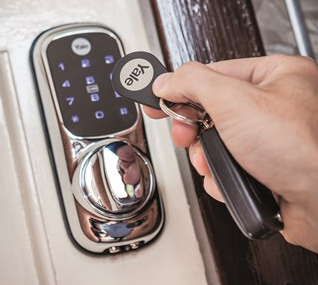
For various reasons, not least because I wanted to play with it, we have a Yale Keyless Connected Smart Door Lock with a Z-Wave module (we have the v1 module which works fine). This lock has a couple of key features that we liked:
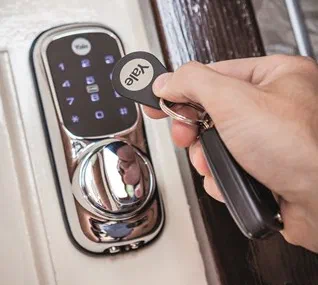
- You can grant or revoke access using RFID tags or cards, or by entering a 6-8 digit code on the keypad.
- With the Z-Wave module (and a compatible Z-Wave controller), you can programatically add and remove codes so that you can enable codes at specific time or dates. For us, this meant we could create a code for the cleaner, but if they turned up at 2am on a Saturday, the door wouldn’t open for them.
It’s connected to our Samsung SmartThings hub, and i run the RBoy Apps custom device type and smart app to enable the scheduled key rotation etc. Overall, we’ve been fairly happy with it, but the thing really does eat up batteries, and I started to feel guilty about putting between 4 or 8 AA batteries in the bin each month. Of course I also got annoyed at constantly having to buy them and change them, so I decided to try rechargeables.
Daniel Rausch, Amazon’s Vice President of Smart Home, reveals that it took 3 years to get to 4,000 Alexa-compatible devices on the market, but in the past 9 months that number has risen from 9,000 to 20,000, helped in no small part by Amazon’s efforts to simplify OEM vendor adoption through SDKs, hardware development training, supply chain options and more. So where does Amazon see this ending up? “The sky’s the limit … you will also see that Alexa will just be embedded in more devices and customers will stop thinking about talking to a device per se. It will become more about speaking at large.”
https://www.techradar.com/news/amazon-soon-we-wont-talk-about-the-smart-home-but-a-world-of-smartsHome isn’t just where the smart is
The Verge has published a great round up on 5G, outlining the technical background, (US) carrier rollout plans, chip manufacturers, and phone vendor plans.
https://www.theverge.com/2018/9/7/17829270/5g-phone-cell-mobile-network-hardwareThe state of 5G
It’s only September, and already people are thinking about Christmas shopping, or so Amazon would have us believe. In what’s pitched as an example of data science at scale, but which a cynic might refer to as a solid marketing campaign, Amazon’s published their “Top 100 toys” to put under the Christmas tree, apparently based on recent sales and product searches.
https://www.amazon.com/b/ref=Top10018GNO/ref=nav_shopall_Top10018GNO?_encoding=UTF8&node=17911189011&pf_rd_p=3dfdd357-c450-4a32-aa11-180e30e86c1c&pf_rd_s=nav-sa-toys-kids-baby&pf_rd_t=4201&pf_rd_i=navbar-4201&pf_rd_m=ATVPDKIKX0DER&pf_rd_r=R03RC9P44A6RWFYTZFYXOnline shopping for Holiday Toy List: Top 100 Toys from a great selection at Toys & Games Store.
Sometimes the code i write doesn’t work 6 months later - so I was incredibly impressed to read about the NASA team who reprogrammed the Voyager 1 space probe some 37 YEARS after the code was last changed. I can’t imagine what the 40 hour wait between sending the commands and receiving the response was like.
https://www.nasa.gov/feature/jpl/voyager-1-fires-up-thrusters-after-37The Voyager team is able to use a set of four backup thrusters, dormant since 1980, for orienting the spacecraft.
Although we’re all used to resetting our smartphones before we sell them, I have to admit that i often forget to wipe the memory of the carplay-enabled hire cars I used over the summer before returning them to the hire company. The Register highlights growing concern among a range of stakeholders - but not car manufacturers - around the privacy and security implications of my forgetful behaviour.
https://www.theregister.co.uk/2018/09/07/connected_cars_privacy/Manufacturers seem reluctant to do anything about it
In their 2018 Salary Survey, Stack Overflow reveals a global increase in Software Engineer salaries, with some locations like London and San Francisco seeing rises in median salary of around 25%, with DevOps engineers commanding the highest pay. Check out how your salary compares here - https://stackoverflow.com/jobs/salary - and read the explanatory blog here:
https://stackoverflow.blog/2018/09/05/developer-salaries-in-2018-updating-the-stack-overflow-salary-calculator/Today we launched the 2018 update to the Stack Overflow Salary Calculator, a tool that allows developers and employers to find typical salaries for the software industry based on experience level,…
In a push to increase collaboration between the UK and Canada on industrial uses of AI, the UK government has teamed up with Canadian aircraft manufacturer Bombardier to offer a prize for ideas which solve an interesting problem - an optimal, self managing de-icing strategy for aircraft. De-icing causes extra fuel burn - either to carry the weight of ice-melting fluids, or to power heating elements at key points on the plane. Also, deicing at the wrong time can lead to other risks - such as ice forming in places not protected by countermeasures. £100k is up for grabs.
https://www.theregister.co.uk/2018/09/07/ice_ice_baby_airliner_ai/Stop, collaborate and listen: Ice is back we need a brand new invention
In what must have been a fun project, creative agency redpepper has built a robot which can play Where’s Wally (Waldo in the US) using Google’s AutoML Machine vision service.
https://www.youtube.com/watch?v=-i7HMPpxB-YWe built a little robot called “There’s Waldo” to test the capabilities of Google’s new AutoML Vision service. We’ve found that technologies can be unapproac…
As more and more teams work with the Arcade Learning Environment to train RL models on Atari games, it becomes more important to a) ensure that comparisons are truly like-for-like and reproducible, and b) find ways to speed up and simplify model iteration. Google has developed a Tensorflow framework, called Dopamine, allowing researchers to focus on the content of their tests and code, rather than spending time iterating and tweaking.
https://ai.googleblog.com/2018/08/introducing-new-framework-for-flexible.htmlPosted by Pablo Samuel Castro, Research Software Developer and Marc G. Bellemare, Research Scientist, Google Brain Team Reinforcement lear…
One problem with existing training methods for unsupervised learning used in human language translation is the availability of text “pairs” (such as the same sentence written twice) between obscure languages - such as Welsh to Urdu. Facebook is testing out a new mechanism involving “word embeddings” - vector-space representation of words in a given language (e.g. kitty -> cat is closer than kitty -> rocket). Using this model, the relative positions of words can be used to create the translation between languages for which there is little existing identical material. Although promising, performance is still lower than using supervised methods.
https://code.fb.com/ai-research/unsupervised-machine-translation-a-novel-approach-to-provide-fast-accurate-translations-for-more-languages/Automatic language translation is important to Facebook as a way to allow the billions of people who use our services to connect and communicate in their preferred language. To do this well, curren…
Looking for a way to pick up Python? Georgia Institute of Technology recently launched Code Shrew, a free, web-based learning platform for Python and object-oriented programming.
https://www.theregister.co.uk/2018/08/07/code_shrew_python/Shrew’d thinking: Code Shrew helps peeps who want to, or need to, gobble a slice of Py
A recently published poll shows that Americans are turning cold on one of the hottest technology frontiers - self-driving cars. A recent study showed that nearly half of drivers now say they’d “never” buy a Level 4 autonomous car, up from 30% two years ago, and Level 2 automation (which is recognised as being risky given the significantly increased cognitive effort it requires) is now the most popular option among those presented. The drop in enthusiasm for self-driving cars is not correlated with awareness of recent accidents involving the technology - but perhaps with a softening in hue of the rose tinted glasses we are using to project AI.
http://www.autodealermonthly.com/channel/dps-office/news/story/2018/08/study-autonomous-vehicle-awareness-rising-acceptance-declining.aspxA new study from Cox Automotive shows that consumers now have a deeper understanding of the complexities involved when creating a self-driving car, which is causing them to reconsider their comfort…
Boston Dynamics has finally started to pivot from research towards manufacture of commercial products, with the following uses as priority:
- entertainment - the first and easiest scenario
- emergency response - eg search and rescue, surveillance
- Security - think about automating property line walks etc.
Longer term, they see their devices:
- warehouse logistics - although not clear why a wheeled robot isn’t a better fit
- parcel delivery - jumping from the back of a truck to deliver a parcel
In a clear message to publishers (“We are not interested in talking to you about your traffic…That is the old world and there is no going back”), Facebook has reminded them both of the power it wields, and of their responsibilities - it’s not Facebook’s job to revive the business model of old school publishing, and deceptive practices like getting users to sign up for a monthly subscription without telling them up front the ongoing cost (https://www.thetimes.co.uk/subscribe/), or making them call you on the phone during restricted hours to cancel (https://login.thetimes.co.uk/links/terms), seem like the desperate throws of a dying beast.
http://www.niemanlab.org/2018/08/facebooks-message-to-media-we-are-not-interested-in-talking-to-you-about-your-traffic-that-is-the-old-world-and-there-is-no-going-back/That firehose isn’t opening up again anytime soon.
At $10,000 for the top end card, NVIDA is clearly aiming these at professional video editing suites, but the addition of built in Tensor Core units aims to speed up end to end editing of film and game graphics - perhaps automating the removal of guide wires from shots, or removing artefacts or entire actual objects from scenes. I just wish the name (“Turing Architecture”) had been saved for a truly self-aware device :)
https://techcrunch.com/2018/08/13/nvidias-new-turing-architecture-is-all-about-real-time-ray-tracing-and-ai/In recent days, word about Nvidia’s new Turing architecture started leaking out of the Santa Clara-based company’s headquarters. So it didn’t come as a major surprise that the company today announced…
AI models are complex and take time and compute power to generate - meaning they’re expensive and valuable. IBM has been developing a way to “watermark” deep learning models by embedding specific information in to the model during training such that it’s impossible (or very hard) to remove later, allowing definitive identification of model theft.
https://thenextweb.com/artificial-intelligence/2018/07/20/ibm-came-up-with-a-watermark-for-neural-networks/How can you tell if someone stole your AI models? IBM proposes a watermarking technique to protect AI developers and their intellectual property.
HBR’s list of steps to making your AI projects more likely to be successful:
- ensure your purpose is clear. AI only adds value in the context of your business model and processes.
- chose carefully what you automate - the value is in expanding human effectiveness, not replacing humans entirely
- pick the right data - more data isnt necessarially better - you need the right data.
- finally, move people to higher value tasks - AI doesn’t really reduce labour costs or headcount, it allows you to better use those people.
https://hbr.org/2018/07/how-to-make-an-ai-project-more-likely-to-succeedStart by having a clear sense of its goals.
Indian researchers have created a solution capable of detecting motorcycle drivers riding without a helmet. When linked to existing surveillance systems and the police, the technology could identify riders and then alert police teams further up the road to intercept them. Hopefully, it’ll be used to improve road safety.
https://economictimes.indiatimes.com/tech/software/iit-hyderabad-develops-artificial-intelligence-to-catch-bikers-without-helmets/articleshow/65109382.cmsIIT researchers have developed a solution for the automatic detection of those riding without helmets.
In a scary development, China expects to deploy AI powered submarines capable of executing weapon strikes on targets within the next 2-3 years.
https://www.artificialintelligence-news.com/2018/07/23/china-sea-power-unmanned-ai-submarines/China is planning to upgrade its naval power with unmanned AI submarines that aim to provide an edge over the fleets of their global counterparts.
Although some are pitching it as “replacing” human call centre workers, a more likely scenario is that mundane or routine interactions can be completely automated, allowing human workers to spend more time on more meaningful, complex or sensitive activities. Yes, this will probably lead to individual call centres hiring fewer people, it could well pan out the same way as ATMs (http://www.aei.org/publication/what-atms-bank-tellers-rise-robots-and-jobs/) - it made the cost of banking cheaper, meaning banks could extend their reach further and open more branches.
https://bgr.com/2018/07/24/google-ai-call-centers-focus-of-software/This is the second time in a matter of just a few weeks we’re back writing about how Google is working on artificial intelligence software to replace human call center workers.
Planning how to deploy people and resources (like water and fertiliser) to make the best use of yield is critical to optimising costs in highly volatile industries like wine making. Using drones to survey vineyards (which takes just 15 minutes), and analysing the results using AI, produces faster and more accurate results - the system can even identify grapes which have been too close to bushfires (which would taint the wine with a smokey taste), and can predict with high accuracy when grapes are at their optimal time for harvesting, ensuring that the exact ratio of sugars, mature and just ripe grapes is ready for picking.
https://www.opengovasia.com/articles/artificial-intelligence-and-machine-learning-to-improve-australias-winemaking-industryJul 27, 2018 - by Teresa Umali - Winemakers can see in real time which grapes are ready to pick using handheld device that uses near-infrared wavelengths. - opengovasia.com
Although (in theory) any randomly scrambled Rubik’s Cube can be solved in 20-26 moves, current solutions are basically based on brute force searches. Given the massive number of combinations (4.3 × 10^19), one major challenge to training a system is the sparse reward mechanism - DeepMind’s paper outlines the use of a new algorithm - “Autodidactic Iteration” - using 2,000,000 iterations over approximately 8 billion cubes in just 44 hours.
https://www.hpcwire.com/2018/07/25/new-deep-learning-algorithm-solves-rubiks-cube/Solving (and attempting to solve) Rubik’s Cube has delighted millions of puzzle lovers since 1974 when the cube was invented by Hungarian sculptor and
Driving increased “data gravity” means customers are less likely to divert new data workloads to alternative platforms, and SalesForce’s two recent acquisitions - MuleSoft (a data integration and transformation company) for $6.5 billion in March (https://www.fool.com/investing/2018/03/23/salesforcecom-makes-a-transformative-move-for-the.aspx) and Datorama (cloud AI for marketing) for $800 million (https://www.fool.com/investing/2018/07/27/salesforce-strengthens-its-ai-capabilities-with-an.aspx) further highlight their desire to make it as easy as possible for customers to get data on to their platform and process it there.
https://www.fool.com/investing/2018/07/27/salesforce-strengthens-its-ai-capabilities-with-an.aspxThe relationship management software company has announced its fourth acquisition this year.
Recent advances in AI mean that it would now be possible to develop autonomous weapons - systems which are capable of making automated decisions to take human life. Elon Musk, DeepMind and others have signed a pledge never to create AI weapons:
“We the undersigned agree that the decision to take a human life should never be delegated to a machine. It goes on to warn “lethal autonomous weapons, selecting and engaging targets without human intervention, would be dangerously destabilizing for every country and individual.”
https://www.forbes.com/sites/samshead/2018/07/18/elon-musk-deepmind-founders-and-others-promise-not-to-make-lethal-ai-weapons/#165c8a1b7269The signatories have promised to “neither participate in nor support the development, manufacture, trade, or use of lethal autonomous weapons.”
A big step towards making devices like Alexa or Siri (or more likely Google Assistant, given that this research comes from DeepMind) better understand humans is the development of “theory of mind”. By around 4 years old, human children can understand that their beliefs may diverge from those of others, and that understanding that divergence can help predict likely future behaviour of others - applying this to human interaction might make the experience more natural. A first step, DeepMind’s algorithm is able to analyse the behaviour of AI systems which are otherwise too complex for people to understand and to try to predict their behaviour.
http://www.sciencemag.org/news/2018/07/computer-programs-can-learn-what-other-programs-are-thinkingAlgorithms achieve a machine theory of mind
Among many promising applications for AI in medicine, cardiology is one with the greatest potential. Current clinical practice calls for manual analysis of a wide range of complex diagnostic imagery, and this analysis is time consuming and error prone, even for the most experienced doctors. Advances in the technology are hampered by ethical concerns that augmenting human decisions with AI violates the relationship between doctor and patient.
https://www.news-medical.net/health/Artificial-Intelligence-in-Cardiology.aspxThe continuous development of the technological sector has enabled the industry to merge with medicine in order to create new integrated, reliable, and efficient methods of providing quality health…
Following the controversy around (and expiration of) Google’s $15 million contract with the US Department of Defense (https://mashable.com/2018/06/02/google-defense-department-project-maven-contract-not-renewed/?europe=true#ebCfKFgiPPqN), the US government has now signed an $885 million contract with Booz Allen - and i’m willing to bet that there will be far less public debate around the ethics of the applications of technology under this contract than with Google.
https://blogs.wsj.com/cio/2018/07/30/pentagon-signs-885-million-artificial-intelligence-contract-with-booz-allen/The U.S. Department of Defense will for the first time be using large-scale AI systems that could automate mundane tasks and augment the work of military members. The contract also will go toward…
Yet another example of the value of simulated training, researchers at OpenAI trained a robotic hand using hundreds of years of object manipulation inside a computer simulation. The resulting hand movements are significantly more dexterous than anything developed so far.
https://www.technologyreview.com/s/611724/artificial-intelligence-driven-robot-hand-spends-a-hundred-years-teaching-itself-to-rotate/A reinforcement-learning algorithm allows Dactyl to learn physical tasks by practicing them in a virtual-reality environment.
In an interesting piece of research intended to highlight the biases embedded in AI systems and training data, a team at the University of Melbourne produced a system capable of making assessments of physical attributes and the emotional state of people in a photo. Hidden in the assessments are a range of biases - gender is assumed to be a binary state, there are only five ethnicities, and emotional judgement or “responsibilities” are clearly highly subjective.
https://www.digitaltrends.com/cool-tech/biometric-mirror-judges-your-looks/Would you be freaked out if a facial recognition mirror started making judgments about your age, gender, race, attractiveness, and even trustworthiness? Get ready to meet the Biometric Mirror, a…
Two years after the unveiling of the original Tensor Processing Unit, Google’s announced “Edge TPU” - tiny AI accelerator chips designed to be embedded in IoT devices. Models will be trained on large, server clusters like today, and then embedded in edge devices in factories or workshops - perhaps analysing samples for quality control, processing movement of objects around a plant, etc.
https://www.theverge.com/2018/7/26/17616140/google-edge-tpu-on-device-ai-machine-learning-devkitThe hardware is destined for enterprise applications, not your phone
In a major breakthrough, researchers from Deep Mind have improved the accuracy of AI lip reading, with half the error rate of previous methods, and over 50% accuracy. If embedded in to smart devices, it could make lip reading accessible to anyone with a smartphone - both helping the many people who struggle in noisy and crowded environments, and putting at risk the privacy of many others.
http://www.sciencemag.org/news/2018/07/lip-reading-artificial-intelligence-could-help-deaf-or-spiesA new algorithm silences its competition
One obvious use case for autonomous cars is to ferry people on the “last mile” between their starting point (e.g. home, office etc.) and public transport, and Google’s Waymo has started a pilot programme in Phoenix to help evaluate the model.
https://techcrunch.com/2018/07/31/waymo-partners-with-phoenix-to-connect-people-to-public-transit/Waymo, the former Google self-driving project that spun out to become a business under Alphabet, is launching a program in Phoenix next month that will focus on delivering people to bus stops and…
One of the questions we often ask in interviews is for a candidate to talk about a piece of data they’ve seen recently which surprised or interested them - an interest in data journalism is (for my team) an indicator of a person interested in numbers, a prerequisite for a successful career in data and analytics. These sorts of data are going to become more accessible as Google News starts to include them in search results to help quash “fake news”
https://www.engadget.com/2018/08/01/google-search-data-journalism/Google is shining its Search spotlight on useful news data.
Perhaps further evidence that “fitting to a curve” can produce syntactically and mathematically correct prose (e.g. which rhymes, has the correct pace and tone), without truly understanding the meaning of the content that’s being generated, the emotion is missing. I’m sure simulation will continue to improve, but without true understanding of the causal link between words and the emotions they invoke, it’s hard to see how truly creative, emotionally evocative content will ever be generated.
https://www.datanami.com/2018/08/01/deep-speare-emulates-the-bard-with-ai/A deep learning model trained on 2,700 of William Shakespeare’s sonnets is giving poetry fans fits trying to tell the AI-generated poems from the real
Tesla claims its custom AI chips are capable of processing 10x frames per second compared to their current off the shelf NVIDA chips - opening up a wide range of future development opportunities.
https://www.cnbc.com/2018/08/01/elon-musk-says-tesla-ai-chip-project-is-finally-coming-to-fruition.htmlElon Musk said Tesla has been working on a self-driving chip for three years.
I’ve never considered before what’s missed when faces are “blurred” to provide anonymity - of course, you lose facial expression and so emotions. A new technique allows faces to be anonymised without losing that expressive motion.
https://www.sciencedaily.com/releases/2018/08/180801131551.htmResearchers have devised a way to replace the use of ‘blurring’ faces in news reports when anonymity is needed. The team’s method uses artificial intelligence (AI) techniques that aim to improve…
The Large Hadron Collider generates more data per second than Facebook collects in an entire year - even after compression, it’s far too much to store. Through clever use of AI and machine learning, applied in real time, the data can be analysed almost as it’s generated, and the system decides for itself what dat to keep and what to chuck. More recently, the teams have started deploying deep learning with networks many, many layers deep. But there’s more to come.
https://phys.org/news/2018-08-particle-physicists-team-ai-toughest.htmlExperiments at the Large Hadron Collider (LHC), the world’s largest particle accelerator at the European particle physics lab CERN, produce about a million gigabytes of data every second. Even after…
In an interesting piece reminding us that “it’s not their fault, it’s yours” if people can’t follow your user interface to access features they want or could find useful, Fredric Paul argues that, without more and better thought on usability and proper reconsideration of user interfaces for functionality not just to make it “sexy”, IoT “for seniors” will end up no-where, and the potential for devices to help with elder care will never realise their full potential.
https://www.networkworld.com/article/3294198/internet-of-things/why-iot-for-seniors-is-a-lot-tougher-than-it-looks.htmlSenior citizens are often touted as a huge potential market for the Internet of Things (IoT), but progress may be slower than a retiree with a bad hip.
We hear a lot about the biases and problems inherent in AI development and use - but this is an interesting approach to solving some societal problems using AI. A piece of software scans news articles and scientific citations to try and identify scientists who are notable but not represented in existing Wikipedia articles, creating draft biographies for human editors to review and publish. So far 40,000 summaries have been produced for both men and women. The article includes a description of the development and training approach taken by the developers.
https://www.wired.com/story/using-artificial-intelligence-to-fix-wikipedias-gender-problem/A software program from Primer scours news articles and scientific journals for women scientists who don’t have entries in the online encyclopedia.
The ACLU and nearly 70 other civil rights oranisations have pressed Amazon to stop selling facial recognition technology to governments over fears of misuse. Microsoft has also asked the government to step in and regulate the technology, and others are calling it “the most uniquely dangerous surveillance mechanism ever invented”.
https://medium.com/s/story/facial-recognition-is-the-perfect-tool-for-oppression-bc2a08f0fe66It’s easy to accept an outwardly compelling but ultimately illusory view about what the future will look like once the full potential of facial recognition technology is unlocked. From this…
eBay describes 5 key approaches which have helped them drive incremental sales of more than $1 billion per quarter i.e. generating sales which otherwise wouldn’t have happened “quarter after quarter, and year after year”.:
1. deep learning has valuable use cases today
2. there are potential applications right across the business, many invisible to users but with tangible benefits (e.g. “right pricing”, improving advertising, predicting delivery windows)
3. “big data” isn’t new - what’s new is crossing the cost inflection point
Apparently the global market for AI was $2.65 billion, mainly focused on a few core suppliers. The US is the biggest single spender at over 35%, and although text processing was the most common used application in 2017, this is clearly expected to move towards video and other media over the coming years.
https://www.techrepublic.com/article/ai-software-market-to-hit-78b-by-2025-here-are-the-top-applications-for-the-technology/The market for AI software is exploding, with IBM and Google leading global suppliers, according to QY Research.
Looking for useful top tip to tune your resume? Dont list your job title, describe your achievements. In particular, what projects did you do? How did data inform the outcome? What skills did you demonstrate that show complexity or breadth?
http://uk.businessinsider.com/tips-for-resume-amazon-jobs-2018-7Your résumé is a recruiter’s first impression of you during the job search. To impress recruiters like Celeste Joy Diaz, a recruiting manager at Amazon…
As if to back up concerns that grocery retailers should be scared of Amazon’s entry to the segment, Whole Foods customers are reporting mainly positive improvements since the purchase by Amazon last year, including higher quality merchandise, and of course, the promised lower costs.
https://www.512tech.com/technology/survey-says-whole-foods-customers-have-liked-changes-since-amazon-takeover-but-have-they-been-enough/jZVnZbZDCbW07wAqnUdc0I/According to a new survey released by market research firm Morgan Stanley, Whole Foods customers indicated they have had a better overall experience at the grocer since Amazon took over last fall.
A further useful insight from the CNAS report is the list of properties of successful AI adoption which should guide both private as well as state interests:
- possessing large volumes of the right data
- training, enabling and sustaining people with the right (AI) skills
- identify the correct incentives for adoption - including recognition of AI as a general purpose tool
- ensure strong collaboration between public and private actors, including development of appropriate regulatory frameworks (e.g. balance of privacy vs. public interest, or whether distribution of AI-specialised hardware should be controlled like weapons are today)
https://www.cnas.org/publications/reports/strategic-competition-in-an-era-of-artificial-intelligenceDeveloping strong, pragmatic and principled national security and defense policies.
In choosing to frame previous industrial revolutions in terms of warfare and the balance of power between state actors (instead of, say, improvements to the lives of individuals, redistribution of wealth to reduce global inequality, or the generation of new forms of capital and “worthwhile” work), the authors are able to articulate a clear set of actions for the US (or any) government who wants to build and cement a technological advantage in to a global projection of power.
https://www.cnas.org/publications/reports/strategic-competition-in-an-era-of-artificial-intelligenceDeveloping strong, pragmatic and principled national security and defense policies.
I’m not sure I’d call facebook (media), Amazon (retail, logistics), uber (cabs) etc. technology companies now either. Yes, they are heavily technology-leveraged, but ultimately the machine under the covers matters less than what it achieves. Walmart, like many large companies, is identifying that significant new business opportunities can be released by better leveraging technology. Does that make it a “tech company”?
https://www.technologyreview.com/the-download/611674/walmart-wants-us-to-believe-its-turning-into-a-tech-company/Its latest partnerships and new services show the retailer’s continued evolution toward becoming a tech-focused business.
I’m not sure what to make of this report. I remember reading about the history of “online dating” and how it is all basically smoke and mirrors (if people believe “the computer” paired them for a reason their dates are more likely to be successful https://www.theguardian.com/lifeandstyle/2014/feb/09/match-eharmony-algorithm-internet-dating), so does AI really help?
https://www.engadget.com/2018/07/12/hinge-most-compatible-suggestions/It’s betting that machine learning can find a mutual match.It’s betting that machine learning can find a mutual match.
A recent experiment by Facebook pitted humans against AI to see which was better at helping another robot to navigate a (virtual) walk around an area of Hells Kitchen in New York. The bot had to describe its location using natural language (“I can see the bank on the corner”). Although the AI only scored 50% in this mode, when using “symbols” instead, it was able to beat humans 87.08% to 76.74%. The two AI were able to communicate far more efficiently than humans could. But as a test for their new “MASC (Masked Attention for Spatial Convolution)” model, it was a success.
https://www.engadget.com/2018/07/11/facebook-improves-ai-by-sending-tourist-bots-to-a-virtual-nyc/Virtual guides help a ’lost’ AI find its way.
Often when prescribing multiple drugs, doctors have very little information to judge side effects or drug interactions, and it can take years for drug side effects to be identified, as their discovery is usually purely by chance. Stanford University researchers trained their system on over 19,000 proteins and their drug interactions, which was able to successfully predict drug interactions based solely on the prescribing combinations.
https://newatlas.com/ai-drug-side-effect-prediction-computer-stanford/55426/When a doctor prescribes a patient more than one drug they have no way to predict whether that combination will have an adverse side effect. A new system from Stanford University presents a novel…
There’s a nice breakdown of the usability and scaling challenges the Google Photos team went through with the redesign of their app. Creating a “scrubbable” infinite scrolling page, maximising screen real estate, while maintaining photo aspect ratio, with instant loading and rendering, with libraries of 250,000 photos or more. The compromises and engineering challenges they encountered are laid out with clear explanations. An interesting read.
https://medium.com/google-design/google-photos-45b714dfbed1A peek under the hood
Although it was first to market, Siri is so awful that i hardly ever use it. But with the reorganisation to bring Core ML and Siri under the same part of the company within Apple, and with a new “chief of machine learning and AI strategy”, perhaps we’ll see some improvement.
https://www.theverge.com/2018/7/11/17559358/apple-new-ai-chief-john-giannandrea-siri-machine-learningJohn Giannandrea is tasked with educating Apple’s assistant
All 4 of the “big players” personal assistants - Apple’s Siri, Google Assistant, Amazon’s Alexa and Microsoft’s Cortana started off female (although they now have male voices). LivePerson CEO, Robert LoCascio, “believes the male-dominated AI industry brings its own unconscious bias to the decision of what gender to make a virtual assistant”. Are the tech giants reflecting biases already present in society?
https://www.npr.org/2018/07/09/627266501/the-push-for-a-gender-neutral-siriSiri, Alexa and Cortana all started out as female. Now a group of marketing executives, tech experts and academics are trying to make virtual assistants more egalitarian.
There’s a massive ethical problem here - people expecting medical notes, receipts with personal data, or their emails to only be “read” by a machine may not have given that consent if it was clear a human would read that they ordered takeaway for 2 to their hotel room while on that business trip without their partner. But when i read the Guardian’s article on “fake AI”, i have to say i wasn’t surprised. It reminded me of Andrew Mason’s interview on how he started Groupon (https://mixergy.com/interviews/andrew-mason-groupon-interview/) - the big question was how the business should work, and building technology which may not be usable later was a waste.
https://mixergy.com/interviews/andrew-mason-groupon-interview/Using what one expert calls a ‘Wizard of Oz technique’, some companies keep their reliance on humans a secret from investors
TNW has a brief summary of the ways that machine learning is being used to improve authentication and authorization, with a rundown of a number of approaches used by different companies.
https://thenextweb.com/artificial-intelligence/2018/07/13/authentication-cybersecurity/To some, the future of authentication might look a little creepy. But the explosion of data and connectivity will provide plenty of ways for AI algorithms to distinguish between imposters and real…
First, deepfakes swapped our faces (https://medium.com/huia/live-deep-fakes-you-can-now-change-your-face-to-someone-elses-in-real-time-video-applications-a4727e06612f), now a US company is developing the technology to recreate voices. The therapeutic uses are clear - there are dozens of situations which can lead to a person losing their voice (https://www.entnet.org/content/common-problems-can-affect-your-voice) - and clearly having a computer sound like me as well as speak my words will help maintain a sense of identity. But the potential for malicious use is also clear - the BBC had to find a reporter’s twin to fool HSBC’s voice ID system (https://www.bbc.com/news/technology-39965545). With this all you need is a few clips from facebook or recorded in secret.
https://www.entnet.org/content/common-problems-can-affect-your-voiceIt probably sings better than you, too.
The search for “generalisation” in AI is somewhat hindered by an inability to test for it, so a recent paper by Google’s Deep Mind team provides an interesting insight in to the thought process of teams pursuing this goal. The team generated a number of tests which contain patterns with abstract relationships between elements in the pattern, and between sets of patterns. Within the sets, specific elements are missing, and the researchers found that pattern completion performance was strongly correlated with core model performance. Whether this provides a way to test models remains to be seen and is the subject of further work.
https://venturebeat.com/2018/07/11/googles-deepmind-developed-an-iq-test-for-ai-models/In a new paper, researchers at Google subsidiary DeepMind tested the ability of machine learning models to reason abstractly, like humans.
while an interesting use case for sure, i’m not sure that I would pay $1,000 for a dustbin unless it automatically managed the inventory in my kitchen cupboards for me…
https://www.digitaltrends.com/home/oscar-ai-trash-can-sorts-recyclables-garbage/Autonomous, an ergonomic office furniture company, announced a Kickstarter campaign for Oscar, a smart home appliance. The AI-based device sorts recyclables and garbage. Environmentally-conscious…
In a very interesting and wide ranging talk on the history (including a very early mechanical perceptron) of AI, Carlos Guestrin outlined 4 trends he sees in the future:
1. shift from parallelism (e.g. spark) to HPC (e.g. deep learning on massive GPU clusters) workloads driving insights from huge (rather than “massive”) data
2. a return to specialized hardware (e.g. custom chips, FPGAs etc. for HPC) and the engineering challenges to fix it (e.g. AutoTVM)
In a couple of short but interesting videos, researchers at Honda show us how they’re designing robots to be tolerant of physical risks, such as knocks, which may cause the robot to topple over and sustain damage to itself or others, by hopping or “running” (several fast steps), depending on the direction of the push. The researchers indicate that future developments might include the ability to switch from vertical to horizontal movement i.e. if you push Asimo too hard it’ll drop to the floor and crawl away.
https://spectrum.ieee.org/automaton/robotics/humanoids/asimo-still-improving-its-hopping-and-jogging-skillsHonda is teaching its robots to take longer and faster steps to recover from shoves by transitioning to a running gait, which is exactly what humans do if we need to
I still believe that we have to change the way we’re consuming the earth’s resources if we want to leave to our children anything like the planet we inherited from our parents. But the products like this need to work on the marketing. Who wants to eat algae :)
https://spectrum.ieee.org/video/green-tech/conservation/we-grew-algae-and-asked-spectrum-editors-to-taste-itAlgae could be the environmentally-friendly superfood we’ve all been waiting for. But will anyone actually eat it?
It’s interesting to see how Apple and Facebook are approaching the problem of “fake news” differently. Facebook is sticking to it’s “algorithmic” approach, which i guess would be far more scalable if (and it’s a big if) it can be demonstrated to work. Apple’s employing more people to review the news that’s presented through the hardware/software giant’s own apps, teaching us:
1. the scale of the problem facing Facebook’s is simply orders of magnitude larger (Apple only curates content from a chosen set of sources, not any joe schmoe writing a blog), and
I’m skeptical about the true market for bike sharing. I can see the perceived benefits, and when i lived closer in to central London I used to use Boris Bikes more often, i’ve recently tried to rent “dockless” bikes from several of the companies around London and although they never seem to be available nearby when i want them, cities all around the world (e.g. http://theconversation.com/to-end-share-bike-dumping-focus-on-how-to-change-peoples-behaviour-90016) are struggling with how to stop bike “dumping” - the natural “clustering” of bikes at the end of common commuter journeys.
https://www.theverge.com/2018/7/2/17526892/lyft-buys-motivate-bike-sharing-expansionThe ride-share company will take on Motivate’s existing contracts, like New York’s Citi Bike
The Very Large Telescope has been used to capture the birth of a planet around a star for the first time. Astronomers have long thought that planets grow through accretion of dust collected around stars - and this series of photographs shows this in action, giving us further evidence of the way our own solar system formed.
https://www.npr.org/2018/07/02/625299978/scientists-capture-first-birth-of-a-planetPhotographs of a young planet orbiting a star provide useful information about how planets form and grow.
A new alloy promises sensors in temperatures of up to around 980°C - high enough to instrument engine blocks in cars, or drill heads in industrial machinery. As it’s also conductive, it could be used to make solid state high current switching gear too.
https://www.asme.org/engineering-topics/articles/manufacturing-design/superalloy-rescues-mems-sensorsnull
We are trying to put accessibility at the core of everything we do, and it’s hard - often people see “designing for accessibility” as expensive or time consuming. But it doesn’t have to be. For a start, it’s much cheaper to implement from the beginning than to try to retrofit, and accessible applications are easier for everyone to use, not just those with disabilities or impairments. Most of the pointers in this article are so obvious they shouldn’t have to be stated - but unfortunately many people aren’t even aware of the need to think about them, let alone possessed of the skill to design for accessibility.
https://uxdesign.cc/designing-for-accessibility-is-not-that-hard-c04cc4779d94Seven easy-to-implement guidelines to design a more accessible web ❤️
Chinese Tech Titan Alibaba has introduced a new feature to help sellers write compelling and useful copy for adverts with a few clicks of the neural network. Producing millions of suggestions each day, the “AI Copywriter” aims to reduce the “repetitive, low-value work” activities associated with creating multiple formats of an advert for different media. Claiming that the system “allows people to devote more energy to richly creative work”, this will clearly put lower priced (although not necessarily lower skilled) copywriters in a difficult spot, and would concentrate spend on a smaller number of more “elite” copywriters.
https://www.alizila.com/alibaba-debuts-ai-copywriter/The technology has passed the Turing test and is capable of producing 20,000 lines of copy in a second, said digital marketing arm Alimama.
Self driving cars always seem to be “tomorrow’s promise”. One major reason is the way that machine learning struggles with “generalising” from more specific data. A child doesn’t need to be shown every possible type of chair to learn what a chair is - but throw a few pixels out and your CNN is likely to miscategorise that wolf as a bear (http://advances.utc.sk/index.php/AEEE/article/download/2202/1271), which could have catastrophic consequences, especially if the knowledge is used maliciously. The Verge is asking whether this limit on capability is leading to a dead end - without significant progress in generalisation driving may be simply too unpredictable to be achieveable
https://www.theverge.com/2018/7/3/17530232/self-driving-ai-winter-full-autonomy-waymo-tesla-uberSkeptics say full autonomy could be farther away than the industry admits
This discussion about automation in the luxury goods market (https://www.ft.com/content/dfb9088a-7079-11e8-92d3-6c13e5c92914) reminded me of the chapters in The Man In the High Castle (https://smile.amazon.co.uk/dp/0241246105) where it’s suggested that some hand crafted items are so beautiful that they possess a factor, wu, that makes them desirable, and one of the character’s acquaintances wishes to clone them as “most of the masses still believe in magic”. But cloning the items removes what is intrinsically valuable. To me, automation manufacture of luxury goods seems to follow the same path - removing the skill and artisan nature of their creation threatens the very soul of the items they produce.
https://www.ft.com/content/dfb9088a-7079-11e8-92d3-6c13e5c92914Response by European groups to robot revolution is as varied as their runway styles
As AI becomes closer than ever to creating digital artifacts which are indistinguishable from those generated in real life, I’m left wondering how we manage the risks to our understanding of law and justice - think perhaps of a generated “CCTV recording” of a political opponent committing a crime being submitted as evidence in court, and no person nor machine can definitively prove whether it’s fake or genuine.
https://techcrunch.com/2018/06/16/facebooks-new-ai-research-is-a-real-eye-opener/There are plenty of ways to manipulate photos to make you look better, remove red eye or lens flare, and so on. But so far the blink has proven a tenacious opponent of good snapshots. That may chan…
I’ve long found the sustainability Oracle’s business model questionable - and their latest move to hide (lack of?) cloud revenue growth in their financials further reinforces my view that they are a company on the way down.
https://www.ft.com/content/a4fc61c6-740f-11e8-aa31-31da4279a601Shares slide as analyst worries it may be ‘obfuscating weakness’
We make a lot of use of our Alexa at home, and i’m interested to see how it can help in hotels. Being able to order important but not time-critical services (“alexa, have someone pick up my laundry”), or get information (“alexa, what floor is the gym on”) come to mind. But is it going to be more than a gimmick? I still occasionally visit hotels with those massive Bose speakers with an iPhone 30 pin connector on them. Even when that was the right connector, who ever used them?? I know i just unplugged them to plug my laptop in instead.
https://getpocket.com/s/81JtIAmazon has announced a new program designed to help hotels deploy Alexa’s voice-enabled smarts across their properties. Though Amazon’s Alexa-powered Echo speakers are growing in popula…
Humans are good at tasks which require dexterity and manipulation of flexible materials (like thin tubes or fabric), but often these detailed tasks are associated with big, heavy “chunks” of other things (such as wiring up a heavy car dashboard before dropping it in to place). Typically, people and industrial robots are kept separate to avoid catastrophic injuries, but a new class of robot which is “aware” of its working environment and can react accordingly (e.g. slow down when a human moves closer) promises to make robots even more useful, taking control of the heavy lifting and allowing humans to focus on the complex, fiddly work.
https://www.technologyreview.com/s/611112/this-company-tames-killer-robotsArtificial intelligence can turn the most dangerous industrial robots into helpful coworkers, and that could transform manufacturing.
The move to a cashless society is making steady progress across most of the world. In the UK, for example, more than 50% of transactions were completed cashlessly last year (https://www.ft.com/content/18e3eb92-7201-11e8-aa31-31da4279a601), while in China, UnionPay’s rapid push in to new markets (as diverse as Malaysia, DRC, and Kazakhstan https://www.ft.com/content/a67350fa-1f6f-11e7-a454-ab04428977f9) demonstrates the sheer scale of the opportunity, with the pace of change hardly altered by the introduction of a new competitor (NetsUnion https://www.ft.com/content/9e8e4f50-63ea-11e8-90c2-9563a0613e56). But there’s rightly growing concern about those being left behind (https://gkstrategy.com/cashless-revolution-leaving-people-behind/) and the solutions for that problem are yet to be discovered.
https://www.ft.com/content/18e3eb92-7201-11e8-aa31-31da4279a601UK spending on debit cards overtook hard currency for the first time in 2017
Recognising AI as a “general-purpose machine”, rather than a distinct and immediately implementable tool or technique, can help explain why the anticipated gains are not yet being seen. With the introduction of other general-purpose machines, like the electric motor, the computer, the steam engine, it took decades for companies and industries to identify how they needed to change - simply automating an existing business process is unlikely to give massive benefits. Rethinking how an organisation achieves outcomes independent of the existing process or tooling is - but it’ll take many more years to materialize.
https://www.technologyreview.com/s/611482/the-productivity-paradoxThe mission of MIT Technology Review is to equip its audiences with the intelligence to understand a world shaped by technology.
Novel new approaches to the use of AI - highlighting its use as an augmentation to human judgement, not a substitute - are welcome, but still fall far short of addressing the elephant in the room - most machine learning or AI today is still pure statistical inference, often without even implicit acknowledgement of the path of causation (grass grows when the sun shines - but which causes which?). Until this problem question is addressed, even the new approaches outlined in this article will just be fitting data to a curve.
https://mobile.nytimes.com/2018/06/20/technology/deep-learning-artificial-intelligence.htmlA branch of A.I. called deep learning has transformed computer performance in tasks like vision and speech. But meaning, reasoning and common sense remain elusive.
It’s an often overlooked problem, but although electric vehicles produce zero emissions at point of use, and can be powered entirely with emission free fuel (e.g. renewable power sources), they still contain a lot of rare materials, often mined or produced under somewhat questionable ethical standards, so it’s great to see how the world is starting to respond.
https://www.technologyreview.com/the-download/611518/a-freshly-funded-battery-startup-aims-to-ease-the-cobalt-crunchConamix, a little-known startup based in Ithaca, New York, has raised several million dollars to accelerate its development of cobalt-free materials for lithium-ion batteries, the latest sign…
Although i was aware of the benefits of sparsely connected neural networks, this paper outlines an additional, slightly counter-intuitive property - scale-freeness through a method they call “Sparse Evolutionary Training). Starting from a sparse network, the model randomly adds new connections and drops weaker ones, “evolving” in to a more model which is more complex to define, but ultimately simpler, with fewer “hubs” (scale-freeness), and this less densely connected end state is quicker to stabilise (as it requires fewer calculations) and to maintain and train than a traditional statically connected network.
https://phys.org/news/2018-06-ai-method-power-artificial-neural.htmlAn international team of scientists from Eindhoven University of Technology, University of Texas at Austin, and University of Derby, has developed a revolutionary method that quadratically…
As Sweden turns to an increasingly cashless society, criminals are having to find other ways to line their pockets. Last year a high profile string of robberies of moving trucks of Apple merchandise (https://web.archive.org/web/20180604083500/http://digg.com/2017/sweden-truck-heist) were finally bought to an end by a police sting, but now criminals have started catching and selling endangered species - some can go for around $120,000 per animal.
https://www.theatlantic.com/magazine/archive/2018/06/stealing-owls/559136/As the country ditches cash, some criminals turn to stealing owls.
Uber plans to launch a flying car service (“Uber Elevate”), predicting it’ll be ready around 2025 - progress is being further accelerated by a $20M investment in a dedicated Research and Development site in Paris, Uber’s first technology centre outside the US, focusing on research in to airspace management and overcoming the legal and practical issues this brings up (do you really want hundreds of flying cars zooming over your home?)
https://www.thelocal.fr/20180524/uber-to-invest-20-million-to-build-flying-taxis-in-franceRide hailing app Uber wants to build flying taxis in France and announced on Thursday it would invest €20 million to develop the project.
It’s becoming increasingly apparent that Level 2 “self driving” cars are quite simply dangerous. The most recent incident (involving a Tesla model S which crashed in to a parked police car) has highlighted that partially automating the complex task of “driving” is potentially worse than not automating it at all (http://uk.businessinsider.com/teslas-autopilot-faces-scrutiny-after-accidents-2018-5). But the “paradox of automation” is not a new phenomena - economist Tim Harford has previously written about this problem (https://www.theguardian.com/technology/2016/oct/11/crash-how-computers-are-setting-us-up-disaster), and Alphabet has chosen to skip Level 2 automation entirely, heading straight for vehicles which need no human intervention at all (“level 4” and beyond) http://www.thedrive.com/tech/15848/waymo-is-already-running-cars-with-no-one-behind-the-wheel
The impact of self-driving cars will be felt far and wide. Aside from the obvious (insurance industry, petrol stations, professional drivers, crash repair centres), CB Insights points out that seemingly disconnected industries - like fast food, real estate, media and healthcare - are also set to be jolted from their comfort zones. Not all of these are negative - if you could watch movies while being shuttled around that’s a boon for those who tell internet access and streaming services. Others are more subtle - how the price of real estate will be affected is as yet unclear (and how will that impact public transport?)
https://www.cbinsights.com/research/13-industries-disrupted-driverless-cars/Fast food, real estate, military operations, even home improvement — many large industries will have to shift their strategies in the wake of driverless cars.
“Improvements in compute have been a key component of AI progress” - with compute capacity used by AI doubling every 3.5 months for the last 16 years
https://blog.openai.com/ai-and-compute/?
https://blog.openai.com/ai-and-compute/Since 2012, the amount of compute used in the largest AI training runs has been increasing exponentially with a 3.5 month doubling time (by comparison, Moore’s Law had an 18 month doubling period).
A future of truly intelligent machines requires causal reasoning, not simply “nontrivial curve fitting” (the probabilistic association of cause and effect), argues Judea Pearl. Development of true reasoning - why a given action has a certain outcome, not just that they’re correlated - would allow machines to “ask counterfactual questions” - in effect, to predict how a change creates a likely outcome that has never been seen before - and potentially even develop agency and free will. He puts lack of progress in this area down to a missing “calculus for asymmetrical relations” (knowing that the sun causes the grass to grow and not vice versa).
https://www.theatlantic.com/technology/archive/2018/05/machine-learning-is-stuck-on-asking-why/560675/?single_page=trueJudea Pearl helped artificial intelligence gain a strong grasp on probability, but laments that it still can’t compute cause and effect.
Although Apple seems to be moving their focus for marketing the Watch towards health conscious consumers, there’s a significant number of people who find wearing the device at work absolutely necessary to stay in touch. Many service industry workers are prohibited from checking phones during the workday or while on shift, but checking a watch is acceptable, allowing them to break the monotony of a quiet afternoon without breaking company policies or seeming inattentive to customers - a scenario I hadn’t previously considered (we didn’t even have smartphones when I was working on a shop floor, and i’m not that old!).
https://qz.com/1282210/the-apple-watch-has-found-a-surprisingly-useful-home-in-the-service-industry/If you work on your feet, you know.
I have to admit - Instagram’s switch from chronological to algorithmic content sequencing has left me feeling like i’m missing something if I stop browsing for a minute - but the main culprit for that is bad user interface design (the app instantly swings back to the top of the feed when it relaunches if there’s any new content, meaning you never get to see the older posts), so I’m not convinced that telling people they’re “all caught up” is really going to fix the “compulsive, passive, zombie browsing” they’re worried about.
https://techcrunch.com/2018/05/21/scroll-responsibly/Without a chronological feed, it can be tough to tell if you’ve seen all the posts Instagram will show you. That can lead to more of the compulsive, passive, zombie browsing that research sug…
I remember years ago hearing someone describe Google’s biggest rival not as another search engine, but Amazon - people “view Google as a tool to research products, while Amazon is the place they go to buy”. While it seems likely that Google’s Shopping Actions programme will drive business, I do not see how this will break Amazon’s stranglehold on online ordering, and especially not when Google’s apparent long-term target here is to have people order through a voice UI, potentially having never seen the product. I trust Amazon to fix it when things go wrong. If i use this service, who do i go to? Google? The merchant? No-one?
https://www.forbes.com/sites/shephyken/2018/05/20/look-out-amazon-here-comes-google/If you look beyond other major online competitors, such as Walmart or Target, who can compete against Amazon? The answer may be … Google.
While I admire Elon Musk’s ability to launch big idea after big idea, I have to agree with Schmidt and Zuckerberg - his concerns about AI stink of moral panic. Yes, we need to have the difficult debates around misuse and fairness, but these debates will only be triggered by continuing to explore the possibilities, not by shutting off the tap.
https://www.neowin.net/news/eric-schmidt-thinks-elon-musk-is-exactly-wrong-on-artificial-intelligenceEric Schmidt is the latest person to criticise Elon Musk’s Terminator AI vision. Schmidt said that AI will prove to benefit humanity as populations see ageing populations resulting in fewer workers.
How do you ensure your technically interesting project is truly a force for good, not merely further entrenching existing biases, stereotypes, and social problems? This great set of rules, based on experiences working on AI solutions in low-income countries, can help, regardless of where you’re working:
1. Ask who’s not at the table - are you truly inclusive?
2. Let others check your work - fairness is subjective
3. Doubt your data - does your data suffer from collection bias?
I find it fascinating that there are companies out there large enough, and with specific enough use cases, to justify creating custom hardware to solve their problems. Facebook’s recently confirmed that they’re working on chips dedicated to analyzing live video, to allow them to respond more quickly to unacceptable or inappropriate content (such as suicide or murder being streamed live). Such analysis requires “a huge amount of compute power”, but is certainly an interesting technical, and ethical, challenge. Who helps Facebook determine what content to flag? What happens if it gets it wrong?
https://www.bloomberg.com/news/articles/2018-05-25/facebook-is-designing-its-own-chips-to-help-filter-live-videosFacebook Inc. is working on designing computer-chips that are more energy-efficient at analyzing and filtering live video content, its chief artificial intelligence scientist Yann LeCun said.
Further demonstrating that just having the technology isn’t enough - you have to keep innovating to stay relevant - Stitch Fix first started using AI and machine learning back in 2011, and it’s given them a significant “first mover advantage” - but the commoditisation of these capabilities means that the things they once held as their own are now readily available to anyone who can code and who can collect the data. Trunk Club, Amazon Wardrobe and The Chapar are all hot on their tail.
https://www.forbes.com/sites/bernardmarr/2018/05/25/stitch-fix-the-amazing-use-case-of-using-artificial-intelligence-in-fashion-retailOnline styling subscription service Stitch Fix uses AI in many aspects of its operation. In collaboration with human stylists, Stitch Fix’s algorithms aim to get relevant fashion into the hands of…
While “replacing 300 CPU-only servers on deep learning training” is hardly a benchmark, 15,500 images per second on ResNet-50 is - just a couple of years ago, training throughput would be 1-2 orders of magnitude slower. Also of interest is the approach that Nvidia is taking here - a single compute “node” will be capable of delivering both AI and HPC workloads with extreme performance (the reference implementation claims two petaflops).
https://www.zdnet.com/article/nvidia-unveils-the-hgx-2-a-server-platform-for-hpc-and-ai-workloads/The platform’s unique high-precision computing capabilities are designed for the growing number of applications that combine high-performance computing with AI.
While not the first to develop a virtual world to provide suitable simulations to accelerate reinforcement learning, this world certainly seems to be one of the most complex. It’ll be interesting to see how effective these simulations actually are in the real world; so far though, there are no robots complex enough to actually fully enact what they’ve “learnt”.
https://www.digitaltrends.com/cool-tech/virtual-home-robot-chores/The goal of VirtualHome is to help robots learn tasks by first experiencing them in a virtual system. In the current system, an avatar can perform 1,000 separate actions, broken down as subtasks, in…
The ethical questions raised by Google’s (small) contract with the US military to develop AI are difficult and controversial, but they have to be asked, and i’d much rather they’re asked in a form open to public debate than behind closed doors.
https://www.theverge.com/2018/5/30/17408446/google-ai-guidelines-weaponry-military-pentagon-maven-contractWhere will Google draw the line on weaponized AI?
In further evidence of the “automation increases jobs” argument, Amazon has recently released footage showing how robots in their warehouses make it quicker and easier for “associates” (=people) to pick and pack your order. This increased productivity means that the warehouses with the most robots are the most profitable, and hence employ the most people. The article does not mention whether Amazon’s staff are profiting from this increased productivity the way UPS’ did (https://www.npr.org/sections/money/2014/04/17/303770907/to-increase-productivity-ups-monitors-drivers-every-move) when they massively increased instrumentation on their trucks to achieve a similar level of improved efficiency.
https://www.digitaltrends.com/home/amazon-warehouse-tour/If you’re like us, you probably spend a little too much time on Amazon buying stuff you may or may not need. But what happens after you click the “buy” button? How does Amazon get you your stuff so…
In further evidence of the way the reducing cost of technology is saving lives, USGS posted a video showing unmaned drones sent to map and monitor lava flows following the eruption of Kīlauea in Hawaii. Analysis of the drone footage picked up a previously unknown but fast moving flow heading towards an as-yet unevacuated residential area. After notifying the Emergency Operations Centre, it became clear that a resident was stranded in the danger area, and he was instructed to “follow the drone” to safety. In addition to this sort of direct assistance, the drone allowed teams to track lava advancement rates to prioritise further rescue efforts.
https://www.facebook.com/USGSVolcanoes/videos/2047215991973618/A USGS UAS mission in Kīlauea volcano’s lower East Rift Zone on May 27, 2018, helps prompt and guide evacuations and leads to the successful rescue of a resident after a lava pond outbreak sent a…
In his (very, very long) book ‘The Rise and Fall of American Growth’ (https://www.amazon.co.uk/dp/0691147728), Robert Gordon lays out an argument that not only is growth slower than than people think, but that the growth spurt from 1870 to 1970 was, by all accounts, a one-off, and growth today is reverting back to the long term mean. Xi Jinping doesn’t buy that, arguing that IOT, blockchain, AI, quantum and mobile computing are poised to drive a new spurt of growth which will exceed even that triggered by the industrial revolution. Only time will tell who’s right.
https://www.cnbc.com/2018/05/30/chinese-president-xi-jinping-calls-blockchain-a-breakthrough-technology.htmlChinese President Xi Jinping said in a speech this week that blockchain — the technology underlying bitcoin — has “breakthrough” applications.
Using technology for good - in this case to reduce the amount of pesticide and the cost of seed-stock (you no longer need to buy the special seed which is only available, at a premium, from the manufacturer of the herbicide or pesticide you plan to use) - is what many of us enter the technology industry for. https://www.technologyreview.com/the-download/611196/weed-killing-robots-are-threatening-giant-chemical-companies-business-models/https://www.technologyreview.com/the-download/611196/weed-killing-robots-are-threatening-giant-chemical-companies-business-models/AI-powered weed hunters could soon reduce the need for herbicides and genetically modified crops.
What happens when the network for your IOT or connected devices suddenly announces it’s going to make a change which affects millions of devices at your end customers? How do you convince them to upgrade to a product which is essentially the same as the one they currently have without seeming like you’re trying to scam them? An interesting parallel will happen in 2025 as BT Openreach switches off the UK’s analogue phone network, and millions of alarms, traffic lights, and social care devices suddenly lose connection.
https://www.ft.com/content/cf0e5816-5a97-11e8-bdb7-f6677d2e1ce8?desktop=true&segmentId=7c8f09b9-9b61-4fbb-9430-9208a9e233c8Plan to retire voice network in 2025 has far-reaching consequences
Probabilistic models of natural language processing don’t seem that revolutionary - after all, humans implicitly work this way - but building a practical but generic framework has been a challenge for engineers and researchers for years (we only have to look at the Alexa Prize (https://developer.amazon.com/alexaprize) to see how hard this issue is). Gamalon’s new product claims to solve this issue. It’ll be interesting to see how it turns out.
https://www.technologyreview.com/s/611078/how-uncertainty-could-help-a-machine-hold-a-more-eloquent-conversation/AI startup Gamalon developed a clever new way for chatbots and virtual assistants to converse with us.
Technology can help or hinder. There’s a growing evidence base indicating that overprotective parenting is leading to decreased ability for young adults to manage risk or respond to uncertainty in an inherently chaotic and increasingly fast paced world (and as a result, the pushback against protective playgrounds which sanitise risk is also growing e.g. https://rethinkingchildhood.com/2018/04/19/risk-dangerous-playwork-adventure-conventional-playground/), so I’m interested when I see vendors offer technology which panders to what many consider to be moral panic; overall, I worry that applying technology in this way elevates fears, rather than reducing them.
https://www.zdnet.com/article/kt-launches-nb-iot-based-child-monitoring-service/South Korean telco KT has launched a child monitoring service that uses its national NB-IoT network.
I find my Amazon Echo devices useful in a range of situations - getting travel and weather information quickly while i’m trying to get the kids out the door, converting units or setting timers while i’m cooking, playing music while i get on with tasks, even controlling the lights and heating - but i’ve also never ordered anything from it. I’m not sure why - this report asserts that users “don’t trust” the devices with payment info, but Amazon already has all that, so it must be something else. I guess it just feels unusual to order something without even seeing it?
http://uk.businessinsider.com/echo-owners-dont-trust-it-enough-to-make-purchases-charts-2018-5When Amazon released the first smart speaker in 2014 and Google released its own two years later, we assumed it was to facilitate purchases through their…
I’ve always found IntelliSense to be amazingly useful, and i miss it when i have to use an IDE or language which doesn’t include it, so these AI-based improvements look like they’ll only improve things.
https://blogs.msdn.microsoft.com/visualstudio/2018/05/07/introducing-visual-studio-intellicodeThe official source of product insight from the Visual Studio Engineering Team
Waymo (Google/Alphabet) is finally launching fully automated vehicles. 52 cars will be deployed around their Mountain View offices and will only be able to operate in and arouund that area. Of note however is a second applicant - China’s JingChi which has requested a licence for a single car with a remote person overseeing the vehicle and able to stop or control it in case of emergency. Waymo assert that their vehicles already operate at SAE-Level 4, which includes automatically stopping in case of system failure (https://dryve.com/glossary/what-are-the-sae-automation-levels/), and so there’s no way for staff remotely monitoring the car to take control of it.
https://spectrum.ieee.org/cars-that-think/transportation/self-driving/waymo-filings-give-new-details-on-its-driverless-taxisCalifornia’s DMV has also received an application from the startup JingChi to test fully autonomous vehicles
Recordings of calls between Google Duplex and a hairdresser and restaurant are amazing. The AI interacts just like a human - adding ums and hesitation, and even successfully recovering the conversation when the restaurant staff misunderstood the request. I think this is what most people think of when they imagine a virtual, digital assistant, and I’m certainly looking forward to trying it out.
http://www.bbc.co.uk/news/technology-44045424The search giant unveils an experimental tool that can make appointments by calling businesses.
The most likely reason Uber’s self driving car killed a pedestrian is because of settings designed to increase passenger comfort. While I’m sure Uber would agree that in this case they went too far, it reminds us that autonomous vehicles (and robots in general) live only to the moral code we provide them. An interesting side note in this article highlights Dara Khosrowshahi’s vision that Uber is at the centre of the network of autonomous vehicles - rather than designing specific end nodes, Uber expects to work with others to be the one ring to binding them all together.
https://www.theinformation.com/articles/uber-finds-deadly-accident-likely-caused-by-software-set-to-ignore-objects-on-roadUber has determined that the likely cause of a fatal collision involving one of its prototype self-driving cars in Arizona in March was a problem with the software that decides how the car should…
Over 10% of all randomised controlled trials in education ever, anywhere in the world, have been funded by the UK government. Following the evidence is hard, especially when it challenges the status quo, common practice, or established “knowledge”, so its good to see the UK government putting this money in to establishing a solid evidence base for effective educational practices.
https://www.economist.com/news/britain/21739671-third-its-schools-have-taken-part-randomised-controlled-trials-struggle-getting?frsc=dgA third of its schools have taken part in randomised controlled trials. The struggle is getting teachers to pay attention to the evidence
Why is weather unpredictable? The natural world is governed by thousands of factors, and their relationships are intrinsically chaotic, making them hard to model and so to predict - at least for humans. In most systems the number of variables is so massive that even identifying them is impossible - think about the flickering of the flames of a large bonfire, or how topography affects weather formations. Researchers at the University of Maryland have proven that they can train a machine learning model on the existing time-series data, and the model was able to predict future states approximately 8 times further to the future than a human.
https://www.quantamagazine.org/machine-learnings-amazing-ability-to-predict-chaos-20180418/In new computer experiments, artificial-intelligence algorithms can tell the future of chaotic systems.
Very interesting approach by Google’s researchers to the “cocktail party problem”. The team trained a CNN to determine which person is speaking in a video with multiple overlapping sounds, and to amplify that speech while reducing other noise. Applications include better automated subtitles, and improved hearing aids. https://research.googleblog.com/2018/04/looking-to-listen-audio-visual-speech.htmlhttps://research.googleblog.com/2018/04/looking-to-listen-audio-visual-speech.htmlPosted by Inbar Mosseri and Oran Lang, Software Engineers, Google Research People are remarkably good at focusing their attention on a par…
Stripe’s advances in AI, based on hundreds of billions of data points, have been able to reduce fraud by 25% without materially affecting non-fraud acceptance rates.
https://thenextweb.com/artificial-intelligence/2018/04/18/stripes-ai-fraud-detector-crazy-smart/I’m loath to use the term, but Stripe is a revolutionary product. It allows pretty much anyone to accept card payments just by adding a few lines of code to their site, without having to deal with…
A fascinating set of guidelines for making complex work which we typically say “has” to be done face to face (like designing) effective when the team works remotely. I particularly like the emphasis on using a spectrum of tools to support “stepping up” the “bandwidth” of a conversation from asynchronous text (e.g. email, slack) to synchronous, real-time, visual methods (e.g. video chat). Others, such as drop in sessions for constructive feedback on work items, look equally useful, and i look forward to testing some of these out with the team.
https://zapier.com/blog/remote-design-culture/More and more companies are seeing the benefits of remote work for productivity in the workplace. As Director of Design at Zapier, I frequently get asked the question of how the design process works…
Choosing an effective loss function is a critical part of training ML models. This thought provoking article reminds us to be critical in the choice of this function, especially as in many models the reward function itself is unclear - does a recommendation system (e.g. promoting new articles, or songs) simply create an echo chamber, or does it broadly converge on the mean? Which of these should score higher? If we penalise the system when users don’t click on articles which violate their confirmation bias - are we acting ethically?
http://www.argmin.net/2018/04/16/ethical-rewards/Musings on systems, information, learning, and optimization.
While at first Intel appears to be catching up in the race to develop chips optimised for AI, looking deeper reveals a broader, longer term strategy to develop open code allowing any competing or complimentary framework (Tendorflow, Caffe, MXNet, etc.) to run at optimum efficiency on their hardware. Back to those chips (and the dodgy performance charts) - the authors of this article point out that you get better single chip performance from hardware 3 generations old compared to the newest silicone - although the real measure isn’t single chip, but how to scale out complex models across “farms” of devices, as the big boys (e.g. Facebook) do.
https://www.nextplatform.com/2018/04/20/is-open-source-the-ai-nirvana-for-intel/Intel has been making some interesting moves in the community space recently, including free licenses for its compiler suite for educators and open source contributors can now be had, as can rotating…
A practical example of the importance of appearance: “appearing tall … is linked to increased social status across cultures, which researchers hypothesize has an evolutionary origin: If you were a taller caveman, you were probably better at taking down megafauna.”
https://www.inverse.com/article/43535-mark-zuckerberg-booster-seat-explanationSitting tall gives him the confidence boost he needs.
IBM’s 5 properties of effective AI?
1 Managed (durable infrastructure, effective data pipelines, data and model governance)
2 Resilient (automatic alerts when model drift is excessive)
3 Performant (runs in reasonable time on cost effective infrastructure)
4 Measurable (model accuracy, data volume, value released)
5 Continuous (evaluate and retrain models as needed)
https://venturebeat.com/2018/04/21/ibm-outlines-the-5-attributes-of-useful-ai/A few weeks ago, a dejected CTO told me it took his team three weeks to build a machine learning model. I told him a model in just three weeks sounded great, and he agreed. So why the long face? Be…
Pouring resources in to Alexa, AWS and experiments like Amazon Go, Amazon invested nearly $23bn on R&D last year, nearly 1/3 of the total spend of the top 5 (next come Alphabet, Intel, Microsoft, and Apple).
https://www.recode.net/2018/4/9/17204004/amazon-research-development-rdTech companies claimed the top five spots again this year.
As the cost of AI drops, things which aren’t currently thought to be solvable through prediction will suddenly be viable - and this will primarily be complimented with human judgement. Computers predict better than people can, but then these predictions will be “handed off” to a human to use judgement to determine the response (such as whether or how to act, or to ignore). Ultimately, the authors recommend that companies develop a “thesis” outlining what you plan to “predict” (e.g. what is “best”), the time until AI becomes so embedded that investments without it are not viable, recognising that progress towards that point will be exponential.
https://www.mckinsey.com/business-functions/mckinsey-analytics/our-insights/the-economics-of-artificial-intelligenceRotman School of Management professor Ajay Agrawal explains how AI changes the cost of prediction and what this means for business.
The demise of the retail store may have been (greatly) exaggerated. Yes, many big box stores are disappearing, being unable to compete on cost or selection with online vendors, many companies are turning to technology to survive the change by inviting themselves directly in to customers’ homes, or optimising their supply chain and product ranges using AI and small, local, relevant locations. Others are making the retail store the place you go to try out a physical product which you then buy online, creating “showroom destinations” for customers. One thing’s clear - this battle is not yet lost.
https://www.cbinsights.com/research/retail-apocalypse-survival-technology-trends/We discuss the technologies and trends, from supply chain software to in-store AR technology, that are helping today’s brick-and-mortar retailers stay competitive as e-commerce continues to grow.
“That some big-name apps have removed their Apple Watch apps isn’t a sign that the Apple Watch is failing as a platform: It’s a sign that the platform is evolving [as developers learn what the new form factor is truly useful for]”
https://slate.com/technology/2018/04/apple-watch-popular-apps-are-leaving-the-platform-is-that-a-bad-sign.htmlIt joined Twitter, Amazon, Google Maps, and Slack, among others.
An innovative saving product: “With myAgro’s Mobile Layaway platform, farmers save for seeds, fertiliser and specialised training via scratchcards – in the same way they might buy phone credit”
https://www.theguardian.com/social-entrepreneurs-solving-problems-around-the-world/2018/apr/04/developing-mobile-technology-manage-funds-farmers-poverty-myagro-anushka-ratnayake-skoll-social-entrepreneurship-awardsSkoll Awards for Social Entrepreneurship winner: Anushka Ratnayake, myAgro
A fascinating tool to support developers. I’m proud to say they had only a few recommendations and findings from my code/repositories (although i have subscribed, so i’ll get notifications for others in future too) - and i can see how a tool like this could really help developers to produce better, more supportable, more secure code.
https://techcrunch.com/2018/04/26/deepcode-cleans-your-code-with-the-power-of-aiZurich-based DeepCode claims that their system — essentially a tool for analyzing and improving code — is like Grammarly for programmers. The system, which uses a corpus of 250,000 rule…
An interesting concept - obvious when explained, but of course, many of the good ones are: “While paradigms like imperative or functional programming characterize certain underlying aspects of our mental model of program, gradual programming describes a process by which a mental model is formed”
http://willcrichton.net/notes/gradual-programming/Programming is a fundamentally incremental (or gradual) process, and our programming languages should reflect that. I show several ways in which program models transition over time and discuss how…
While IBM’s latest figures show that perhaps the elephant can’t dance after all (https://www.ft.com/content/84dfe694-432f-11e8-93cf-67ac3a6482fd), Microsoft’s pivot from a software to cloud services company is really starting to pay off - reporting revenue nearly $1bn higher than market expectations last year. Changing the direction has clearly been hard (e.g. disbanding the Windows Engineering team, previously the core of the company), and it’s hard to see how a company of that size, and with that number of highly passionate people, can successfully adapt so quickly, but it seems to be well on track.
https://www.ft.com/content/6add94ac-49a7-11e8-8ee8-cae73aab7ccbRevenue boost from cloud business and upbeat forecast add to stock price confidence
Scratch is a great tool for introducing young children to programming, so I’m glad to see it continues to evolve and grow.
https://medium.com/scratchteam-blog/3-things-to-know-about-scratch-3-0-18ee2f564278A new version of Scratch is coming this August!
Construction sites are perfect examples of chaotic environments - a massive number of moving parts, unpredictable environmental conditions, hundreds of people - and there’s a very real risk of injury or even death for every human present. Automation therefore is highly complex, but the first steps are starting to be taken, with robots moving parts and materials to free up humans to work on the more challenging task of actually building.
https://www.technologyreview.com/the-download/611005/robots-are-going-to-redefine-japans-skylines/Japanese companies are turning to robots to help build their skyscrapers.
Most power outages are due to failures in the transmission network (storms, broken power lines), not instability in supply. Making the move to newer, cleaner energy solutions is going to be difficult and take time - and cause pain for those involved. But that’s not a good reason to prop up old, dirty, under-utilized coal and nuclear plants with subsidies or tricks. Let the newer “old fuel” plants provide the resilience needed, and replace the even older dirty capacity with newer, cleaner energy.
https://www.axios.com/trumps-electricity-solution-in-search-of-a-problem-287efa7b-181f-44a2-85f2-40625e9e22d0.htmlThere’s not a lot of evidence behind his laser focus on coal and nuclear power.
I’d love to have a robot butler. Previous attempts have been hilariously unsuccessful - so i’m not holding my breath - but the goal is certainly worth chasing.
https://www.bloomberg.com/news/articles/2018-04-23/amazon-is-said-to-be-working-on-another-big-bet-home-robotsTen years ago, Amazon introduced the Kindle and established the appeal of reading on a digital device. Four years ago, Jeff Bezos and company rolled out the Echo, prompting millions of people to…
Find yourself snowed under with no time to come up with your next big idea? Most of us come back from holidays refreshed and with new goals and objectives - but how do we achieve that level of innovative ideation on a more regular basis? Make time - two hours a week, locked away from distraction, could be enough. This article includes some tips on getting started.
https://www.weforum.org/agenda/2017/09/einstein-darwin-and-the-two-hour-genius-ruleZat Rana looks at the trait shared by Einstein, Darwin and Nietzsche - taking the time to pause and think.
“AI is probably the most important thing humanity has ever worked on. I think of it as something more profound than electricity or fire,” Google’s CEO, Sundar Pichai, said at Davos said. “Any time you work with technology, you need to learn to harness the benefits while minimising the downsides.”
https://www.weforum.org/agenda/2018/01/google-ceo-ai-will-be-bigger-than-electricity-or-fireThe technology could eliminate many of the constraints we now face, he said.
As more and more services compete for valuable kerb space (deliveries, ride shares, taxis, emergency vehicles), having a common framework, platform, and language to share valuable data on utilisation and timings can help city planners optimise rules and maximise value, ensuring they do this without compromising customer confidentiality (does the city need to know who is getting out in front of the health clinic, or just that it’s a busy place?) https://www.wired.com/story/uber-nacto-data-sharing/https://www.wired.com/story/uber-nacto-data-sharing/?mbid=social_fb&mbid=social_fbThe ride-hailing company is working with DC to share data—and the much coveted curb.
A fascinating insight - what traces would be left of a civilisation which died out 4 million years ago? Certainly nothing on the surface (the oldest is only 1.8m years), and fossils are incredibly rare (only a few thousand dinosaur fossils exist despite their 180m year existence) - but what about chemical traces? https://www.technologyreview.com/s/610886/if-we-werent-the-first-industrial-civilization-on-earth-would-we-ever-knowhttps://www.technologyreview.com/s/610886/if-we-werent-the-first-industrial-civilization-on-earth-would-we-ever-know/?utm_medium=social&utm_campaign=technology_review&utm_source=facebook.comFossils and objects are unlikely to survive more than a few million years. Searching for chemical traces of industrialization offers an intriguing alternative.
Assembling an Ikea chair in 20 minutes, rather than the 5 that a person takes, doesn’t seem like much of an advance. But while computers excel at trigonometry and logic games like chess, evolution’s billion year head start on interacting with the physical environment means that advances like this are drawing us (very) slowly closer to a world where robots can perform menial but unpredictable physical tasks.
https://www.economist.com/news/science-and-technology/21740733-cower-your-silicon-overlords-puny-humans-robots-can-assemble-ikeaCower before your silicon overlords, puny humans
Apple’s new robot, Daisy (an upgraded version of a robot announced in 2016), can disassemble 200 iPhones per hour, sorting the parts for reuse and recycling, extracting parts which traditional recyclers are unable to safely or cost effectively remove.
https://www.independent.co.uk/life-style/gadgets-and-tech/news/apple-earth-day-daisy-iphone-recycling-a8312951.htmlApple has created a new robot – not for building products, but for ripping iPhones apart. The robot, named Daisy, can take nine different iPhones models apart and extract the important parts of them,…
The move to paperless movement of goods in these extraordinarily complex logistics chains has the potential to unlock massive benefits, reducing the cost of movements, by shortening the time it takes for goods to cross checkpoints and borders - an example 32 day journey of perishable goods could be completed in 20.
https://www.bloomberg.com/news/articles/2018-04-18/drowning-in-a-sea-of-paper-world-s-biggest-ships-seek-a-way-outGlobalization has brought the most advanced trading networks the world has seen, with the biggest, fastest vessels, robot-operated ports and vast computer databases tracking cargoes. But it all still…
I have no idea about the game that the author is engineering manager for, but this is a good write up of a framework for assessing technical debt, including the value of resolving it now vs later (never)
https://engineering.riotgames.com/news/taxonomy-tech-debtBill Clark discusses classifying and managing tech debt at Riot.
While I’m sure that eventually, the process could have been automated, anyone who’s tried this even at a trivial scale would tell you to get the process working first, then to automate. So I don’t get how Tesla ended up in this position.
https://www.bloomberg.com/news/articles/2018-04-13/musk-tips-his-tesla-cap-to-humans-after-robots-undercut-model-3Tesla Inc.’s Elon Musk, who’s built up an aura around how automated his car assembly plant will be, has good news for humans: We still need your help.
The clothing industry has long relied on low cost labour in developing countries, but advances in industrial robotics and machine learning and vision, at reducing cost, mean even those jobs are now at risk.
https://spectrum.ieee.org/robotics/industrial-robots/your-next-tshirt-will-be-made-by-a-robotGeorgia Tech spin-off SoftWear Automation is developing ultrafast sewing robots that could upend the clothing industry
“For the past two decades, it was China who learned more from the US,” he says. “But in the next 10 years, we’ll ride on each other’s successes. There’s no point thinking who will surpass who.”
http://www.bbc.co.uk/news/business-43735023The head of China’s ride-hailing giant Didi Chuxing says his team is young, idealistic and full of surprises.
An interesting move from hardware vendor to PaaS provider: The NVIDIA GPU Accelerated Cloud (NGC) for Deep Learning and HPC
https://www.nvidia.co.uk/gpu-cloud/A GPU-accelerated cloud platform with access to catalog of fully integrated and optimized containers for deep learning and HPC frameworks. Learn more.